

Most operators recognize the moment.
The numbers begin moving in ways that are difficult to explain.
Traffic softens in one channel but strengthens in another.
Margins compress even though pricing moved.
Promotions still drive volume, but not the way they once did.
Nothing looks obviously broken.
But the system feels heavier than it did a few months ago.
The response is almost always activity.
Another promotion.
A pricing adjustment.
A push in a new channel.
More initiatives added to the plan.
Sometimes those moves help. Often they simply make the system harder to read.
The problem is not effort.
It is interpretation.
Most leaders manage the results.
Very few manage the growth system itself.
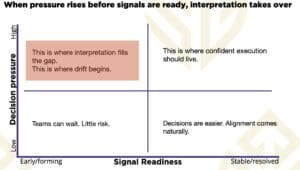
Most organizations are trying to manage growth using numbers that arrive after the system has already moved.
Revenue and margin are useful indicators, but they are lagging signals. By the time they appear clearly in the numbers, the underlying dynamics that produced them have often been operating for months.
That creates a structural problem.
Operators are forced to make decisions while the signals that matter are still forming.
Example
In many organizations you can see this play out in small ways. Promotions that once produced meaningful lift keeps running because removing it would drop the baseline. The system adapts to the promotion, but no one quite remembers when it stopped creating incremental growth.
Growth Is Not Linear
Most growth plans assume a simple model.
You pull a lever such as pricing, promotion, distribution, marketing and the result shows up in the numbers.
In reality, growth systems behave more like cycles.
New initiatives rarely produce immediate clarity. Early signals are noisy. Results arrive unevenly. Eventually a lever begins producing reliable incremental lift.
For a period of time, that lever compounds.
But the compounding never lasts forever.
Over time, the same lever begins to lose incremental power. The lift that once felt like growth becomes part of the baseline. The system continues to function, but the gains stop accumulating.
At that point the organization faces a choice.
Recognize what has happened and begin reinvesting in the next opportunity, or continue pulling the same lever and hope the numbers improve.
Many companies choose the second path, often without realizing it.
The Difficulty of Reading the System
The challenge is that the signals inside a growth system form slowly.
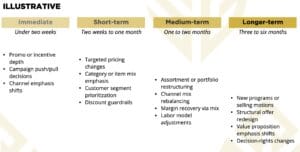
Early movement often looks ambiguous. One week suggests momentum, the next looks like noise. It takes time before patterns repeat enough to separate signal from variance.
Because the evidence is incomplete, organizations frame the decision incorrectly.
The debate becomes action versus inaction.
Should we move now?
Should we wait for more data?
That framing misses the real issue.
Every lever in a growth system moves through phases. Decisions should depend less on the numbers themselves and more on which phase the lever has entered.
Without that discipline, organizations often declare success too early, abandon initiatives before they have formed signal, or continue investing long after the incremental lift has flattened.
Example:
A pricing move might initially improve margin while quietly weakening mix. For a time both effects coexist in the numbers, making the signal difficult to interpret. By the time the pattern becomes obvious, the system has already shifted.
Why the Next Growth Phase Is Usually Underfunded
Even when leaders recognize these dynamics, a second problem appears.
Growth phases overlap.
The lever that produced the last period of compounding rarely stops working immediately. It continues to generate revenue. The numbers still justify the effort.
But because the gains are now part of the baseline, the organization quietly becomes dependent on them.
The result is subtle.
Resources remain tied to yesterday’s growth engine while the next one struggles to get started.
By the time the old lever finally weakens enough to force change, the new opportunity has often been underfunded for months.
Operators sometimes interpret this moment as sudden slowdown. In reality it is the predictable outcome of a system that failed to rebalance itself.
The Cycle Most Growth Systems Follow
Seen clearly, growth systems tend to move through a repeating cycle.
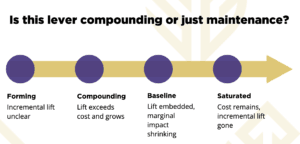
A new lever begins in a forming phase, where signals appear but remain noisy.
If the initiative is supported long enough to separate signal from variance, it enters a compounding phase, where incremental lift becomes reliable and scaling makes sense.
Eventually the system reaches saturation. The lever still works, but the incremental lift declines. What once produced growth now maintains the baseline.
At that point disciplined operators begin reinvestment redirecting resources toward the next forming opportunity before the current one fully fades.
The cycle then repeats.
What Strong Operators Do Differently
Organizations that manage growth systems well do not avoid these dynamics. They simply make them explicit.
They recognize when a lever has moved from compounding to baseline.
They define what evidence would justify scaling or reversing an initiative.
They harvest gains from saturated efforts early enough to fund the next phase.
Most importantly, they resist the temptation to scatter attention across too many initiatives at once.
Many growth levers require reaching a threshold before they produce measurable lift. Spreading effort too widely prevents that threshold from ever being reached.
The result is not resource scarcity but diluted impact.
Example:
It is not uncommon to see organizations running five or six initiatives simultaneously, each receiving just enough attention to exist but not enough to cross the threshold where real lift appears.
Reading the System Before It Moves
The difficult part of operating any growth system is timing.
Move too early and you abandon opportunities that might have compounded.
Move too late and the next phase arrives underfunded.
The difference rarely shows up immediately in the numbers. It appears gradually as the system accumulates decisions over time.
That is why experienced operators often focus less on individual tactics and more on how the system behaves.
When you begin to see growth as a cycle rather than a straight line, many of the confusing signals start to make sense.
And the decisions that follow tend to become simpler.